How to Play Putt Putt: Rules, Putting Technique and Beginner Mistakes
A practical guide to completing a hole, choosing a route and understanding what to change after a missed putt.

The cup looks close enough. Aim at it, hit the ball, and move on. That is a tempting first impression of mini golf.
Then the ball rolls back down a ramp, rebounds into a corner or passes just beside the cup. Should the next shot use a different line, less pace or another route altogether? Those decisions are where the game becomes interesting.
In conventional hole-based mini golf, the aim is to get the ball from the teeing area into the cup in as few strokes as possible. Ramps, borders and obstacles give a short distance several possible solutions. The World Minigolf Sport Federation's introduction describes that same basic objective.
This guide explains recreational play. Organised competition has its own rules; at an entertainment venue, check the posted instructions for out-of-bounds balls, stroke limits and special equipment before starting.
How to complete a hole
- Read the hole instructions. Locate the teeing area, cup, required obstacles and any special scoring conditions.
- Check that the route is clear. Wait until the previous player has left the shot's path and companions are outside the putter's movement area.
- Play from the designated start. Choose your line, set up and strike the ball so it rolls along the intended route.
- Wait for the ball to stop. Follow the hole's rules to decide whether to continue from that position or return to a designated starting point.
- Finish and record the score. Write down your strokes after holing out. If you reach the venue's limit, end the hole and score it as instructed.
- Clear the playing area. Do your scoring and discussion where they will not block the next group.
One distinction matters from the outset: not every mini golf attraction scores strokes into a cup. Some award points for hitting target zones. Establish what counts as finishing before deciding how to play.
Which rules should you check before teeing off?
You do not need to memorise a competition rulebook for a casual visit. You do need to understand the rules that change where you play from and what you record.
| Check before starting | Why it matters |
|---|---|
| Where the ball may be placed within the teeing area | Different starting positions can open different lines. |
| How players in the group take turns | It prevents overlapping shots and someone entering another player's route. |
| Where to continue after failing an obstacle | Some situations require another attempt from the tee; others allow play from where the ball stops. |
| How to handle a ball out of bounds, against a border or stuck | You cannot choose a replacement position or penalty yourself. |
| Whether there is a maximum score or stroke limit | Once it is reached, finish and record the hole as instructed. |
| Whether the hole counts strokes or target points | The objectives differ, so the two systems cannot simply be mixed. |
Formal mini golf also has rules for different course systems. The WMF's rules directory separates the general competition rules from system-specific rules. A ball-relief procedure learned at one venue therefore should not automatically be applied elsewhere.
For example, the German Minigolf Federation's introductory explanation requires a return to the tee if a specified obstacle boundary has not been passed; after passing it, play continues from the resting position under the relevant rules. It also describes recording seven when six attempts have not completed the hole. These are examples from that explanation, not a universal limit for every recreational venue. See the German federation's introduction.
If the instructions leave something unclear, ask staff before playing. It is easier than reconstructing the score afterwards.
Build a putting action you can repeat
Beginners do not need an elaborate grip routine. A repeatable preparation makes it easier to notice what changed from one shot to the next.
Look at the route before taking your stance
Stand behind the ball and look towards your intended target. That target might be the cup, an obstacle entrance, a rebound point on the border or a useful resting area for the next shot.
Choose it before stepping beside the ball. Constantly turning your body while trying to find the line can change the direction you originally selected.
Align the putter face, then arrange your feet
Point the face in the direction you want the ball to start. Then take a comfortable stance with stable feet, a slight forward bend and relaxed arms.
A practical equipment check is whether you can place the putter behind the ball and make a natural stroke without raising your shoulders or excessively crouching. If the setup feels awkward, ask staff to help adjust it or choose another putter.
PGA putting guidance likewise emphasises a stable base, a natural arm position and limited body movement during the stroke. See the PGA setup guide.
Strike the ball rather than carrying it with the face
Move the putter back, bring it forwards into the ball and let it follow through naturally. Do not keep the face pressed against the ball to drag or push it along. The German federation's introduction also distinguishes a stroke from pushing the ball.
A normal putt does not require a high backswing or a full golf swing. Unless a particular attraction expressly calls for and permits another action, start by rolling the ball along the playing surface.
Keep a similar tempo when adjusting distance
An abrupt jab after leaving a ball short, followed by a hesitant stroke after sending it too far, makes distance difficult to compare.
Try keeping a broadly consistent rhythm while changing the length of the backswing and forward stroke. The PGA's distance-control practice uses this approach too.
No fixed stroke length works everywhere. Surface, slope, ball and rebound position all affect the result. A comparable action gives you a clearer basis for deciding what to change.
Keep score while the hole is still fresh
Conventional stroke play compares total strokes, with a lower total producing the better score. Include penalties required by the venue and observe its single-hole limit.
Record each hole when it ends instead of trying to remember a whole round afterwards.
As a scoring illustration, suppose a hole counts each stroke: the first stops before the obstacle, the second passes it and the third enters the cup. With no additional penalty, record three. That is an example of counting, not a claim about the hole's standard score.
Do not assume a replay erases the previous stroke. Failed obstacles, out-of-bounds balls and other incidents are scored according to the applicable rules. Ask about unfamiliar scorecard entries before starting.
Read straight shots, ramps and rebounds differently
Straight shots: separate start direction from distance
If the ball immediately leaves your intended line, first check alignment and contact. If it follows the line but finishes short or long, look at distance control.
This is a way to investigate, not a diagnosis from a single putt. If the ball repeatedly turns at the same spot, also look for a slope, joint or other surface feature.
Keep your preparation even close to the cup. A casual flick changes the action and leaves you with less useful information when it misses.
Ramps: inspect what comes after the crest
Before an uphill putt, look beyond the top. If a bend follows immediately, too much pace may send the ball into a border. If the route includes a specific opening, concentrating only on reaching the crest can overlook the entrance that actually constrains the line.
When a ball returns, distinguish one that never reached the top from one that struck an obstacle and rolled back. The first may call for a distance adjustment; the second calls for checking the line first. Hitting harder is not an answer to both.
Bank shots: follow both sides of the collision
Identify where you want the ball to contact the border and where you want it to travel and stop afterwards. Watching only the contact point can produce a well-placed collision followed by an unhelpful second leg.
Do not treat every rebound as a perfect geometry exercise. Ball movement, border surfaces, joints and impact speed can change the actual route. Observe the result before changing either the contact point or the stroke length.
Use a designated practice area if available. Do not hold up a playing hole with repeated trials.

One hole, three possible decisions
The following is a hypothetical hole used to explain a decision, not a completed project or a real case study.
A narrow straight passage lies between the tee and cup. A border offers a possible bank shot, while a wider resting area sits outside the narrow passage. Assume the rules permit all these routes and allow continued play from the resting position.
| Choice | Aim of this shot | What to assess | Common trap |
|---|---|---|---|
| Play through the narrow passage | Approach the cup directly or attempt to hole out | Can you control the starting line, and where will a miss stop? | Seeing the short route but overlooking the recovery after a slight error. |
| Rebound off the border | Bypass the narrow entrance and approach from the side | Are both legs clear, and does the border offer a usable rebound? | Choosing a contact point without considering the outgoing line and speed. |
| Play into the wider area first | Leave a clear next shot | Will that position genuinely help, and do the rules allow this progression? | Calling a shot safe without improving the next position. |
The direct route has an obvious attraction: success could save a stroke. But a miss into an awkward corner may make the next shot harder.
A bank shot avoids one obstacle while adding a collision to control. Judge it by the border position and the space beyond the rebound, not simply by how entertaining it looks.
Playing to the wider area accepts a staged approach. It is useful only if the following shot becomes easier. If the same obstacle still blocks the line, the extra journey has achieved little.
Before choosing, ask: if this shot does not go to plan, where is the ball likely to stop, and how could I continue?
That helps compare routes. If the hole instead requires a return to the tee until an obstacle has been passed, reassess the staged approach. Strategy depends on what the rules allow.
Use the result to choose your next adjustment
Describe what happened before changing the shot. “That was bad” is too broad to guide the next attempt.
| What you observed | What to check first |
|---|---|
| The ball starts away from the intended line | Putter-face alignment, contact and any last-moment wrist turn. |
| The direction is close, but the ball finishes short or long | Compare stroke lengths while keeping a similar rhythm. |
| The ball contacts the chosen border but goes away from the target | Review the outgoing route, then compare contact point and speed. |
| The ball returns down a ramp | Distinguish failure to reach the crest from a rebound off an obstacle. |
| The ball is too close to the border for a natural stroke | Check the relief rule before forcing a stroke or moving it. |
| Similar putts roll noticeably differently | Look for slope, joints or debris; ask staff to inspect anything doubtful. |
Change one main variable at a time where possible. Changing stance, aim and pace together after a left miss makes it difficult to tell which adjustment helped, even if the next result improves.
Out of bounds, tight to a border and stuck are different situations
An out-of-bounds ball requires the venue's definition of the boundary, replacement procedure and penalty. Leaving the normal route does not give you permission to place it wherever seems nearest.
A ball against a border may still be in play but leave no room for the putter. Whether it may be moved, by how much and in which direction depends on the rule for that hole.
A stuck ball may involve equipment or an inaccessible position. Do not lever an attraction with the putter or reach into moving parts. Note where the ball stopped and ask staff for help.
If the incident affects the group's scores, resolve it before continuing. Once more strokes have been played, the original position may be difficult to establish.
The details beginners miss between shots
Before putting, check that companions are not too close. While someone else plays, do not step into their line to get a better view.
Wait until the ball stops. Catching it early, blocking it for someone or nudging a near miss changes the result.
Obstacles are not seats, steps or supports. Follow the signage and staff instructions when retrieving a ball or entering the playing area.
If a player reaches the hole's limit, finish as instructed. Ask about a practice area or another opportunity to try again without delaying other groups. These habits keep both the playing space and the group's progress clear.
Product recommendations: different holes, different decisions
Understanding direction, distance and route choice makes equipment easier to compare. These three products present different playing tasks. When combining them in a venue, also consider whether players can recognise the objective and understand the instructions.
Golf Parkour Hole: connect successive obstacles
The Golf Parkour Hole organises play around ramps, curved routes and obstacles including rings.
Look at the sequence: after clearing one obstacle, does the ball still have a useful direction and position for the next? Reaching the top of a ramp may solve only part of the route.
This format offers a way to compare lines and stroke lengths. Assess the obstacle entrances, subsequent resting positions and continuation after a miss. Pairing it with more immediately readable cup-based holes can introduce route complexity gradually. Extra obstacles alone do not explain difficulty; players also need to understand why a ball failed to pass.
View this product
Lucky Disc Golf Hole: compare passages and resting positions
The Lucky Disc Golf Hole uses a disc obstacle and a divided layout to create route choices.
Review both the section from the tee to the obstacle and the section from there to the target. Which entrance is easier to read? Where will an off-line ball stop? Is there room for another stroke?
Compared with a sequence of ramps, the emphasis is more on routing around an obstacle and selecting a path. When combining holes, avoid layouts that look different but call for essentially the same shot. Confirm the actual obstacle mechanism and available routes against the chosen configuration rather than inferring them from the name.
View this product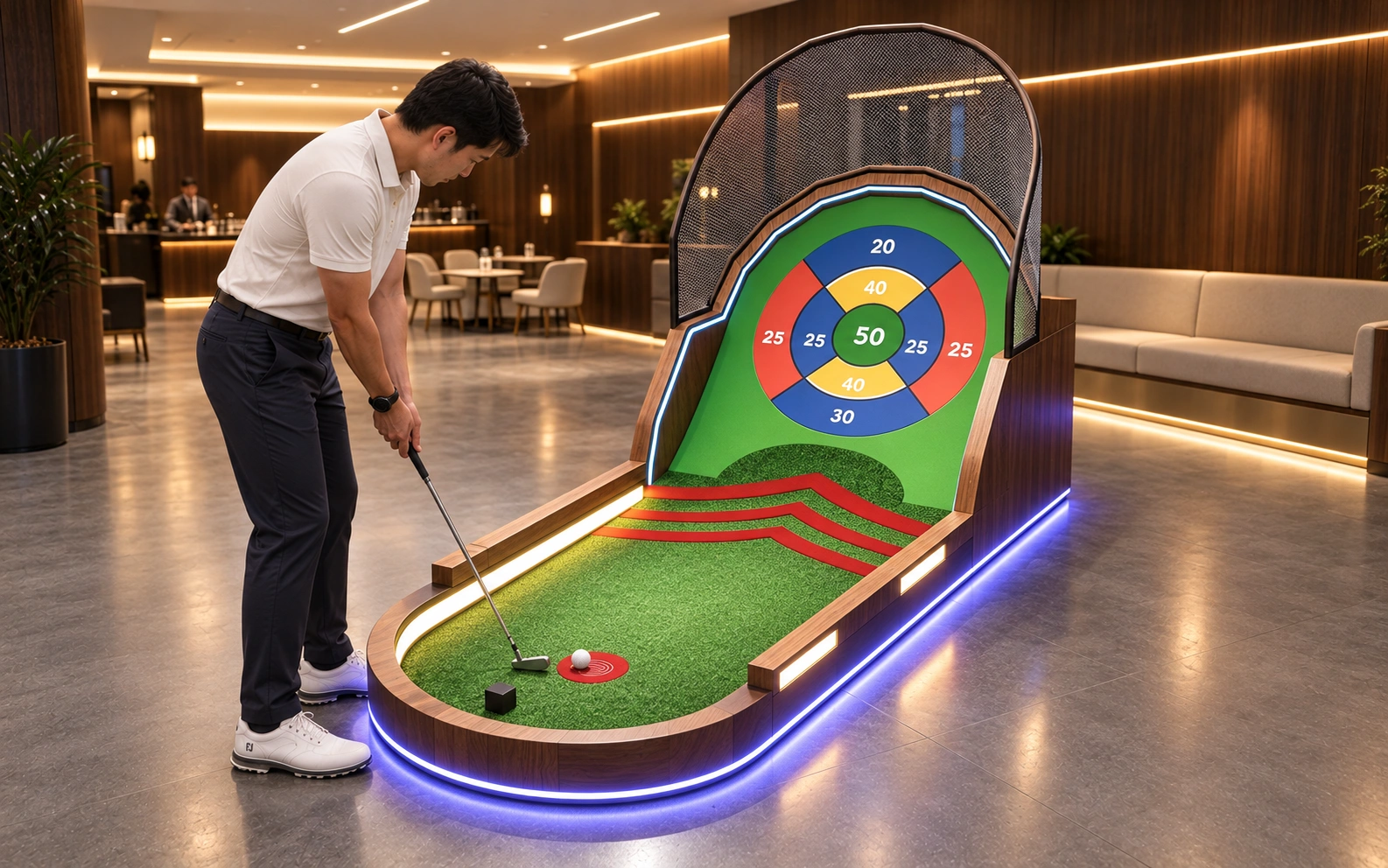
Golf Target Shooting Hole: understand points before choosing a target
The Golf Target Shooting Hole has a target board divided into scoring zones. Its point-based objective needs to be explained separately from conventional stroke scoring into a cup.
Players consider which zone to aim for and what happens if they miss that zone. “The lowest total wins” cannot simply be carried over from stroke play.
If target equipment and conventional holes share a venue, make their scoring clear. Before purchasing, confirm zone values, valid-hit criteria, score recording and ball collection. Do not assume automatic scoring is included in every configuration.
View this productFor operators, the product mix also affects instructions and visitor circulation. Putt Infinity can discuss those connections through custom hole and venue design, then confirm production, installation and maintenance requirements within the project scope.
FAQ
Can I play without any golf experience?
Start with the venue briefing and a straightforward hole. Learn to choose a line, make a natural stroke, wait for the ball and record the score before trying more complex rebounds or obstacle sequences. A full golf swing is not a prerequisite.
If the ball hits an obstacle and rolls back, do I start again?
Check the hole's rule. Some rules use a specified boundary to determine whether play may continue from the resting position. Neither being inside the playing area nor failing the obstacle alone tells you where to play next.
What if my ball hits another player's ball?
Stop and leave the situation as it is. Do not immediately reposition both balls or take another stroke. Ask staff to apply the venue's procedure for restoring positions and scoring. Agreeing the turn order before starting also reduces confusion.
May I move a ball a little away from the border?
Only where the rules permit, and only as instructed. “Just a little” is not a basis for changing the position yourself. If you cannot set the putter naturally, ask staff first.
Can we decide a disputed penalty after finishing?
Resolve it when it happens. Later strokes can make the original position and collision hard to reconstruct. Use the same procedure for everyone in the group, including during casual play.
How should a group with mixed experience organise play?
Agree the rules, turn order and stroke limit first. Experienced players can explain a route before the beginner sets up; avoid several people calling instructions during the stroke. Obtain the venue's agreement for a simplified or alternative game and keep it separate from formal scoring.
How can adults help children take part?
Ask staff about a suitable putter, age requirements and supervision. Watch the swing space and walking route. Give one clear aim at a time, such as getting through the entrance, rather than asking for several technical changes together.
Can target points be added directly to stroke scores?
Do not combine them yourself. A points game may reward a high score while stroke play rewards a low one. Use the venue's conversion or recording system for a mixed format; without one, record the formats separately.
Give the next putt a clear purpose
Before stepping beside the ball, decide where its route begins, which position it should pass and where you want it to stop.
When it comes to rest, compare the actual result. Was the start direction wrong, was the distance misjudged, or did the chosen route leave a difficult continuation? Use that observation for the next adjustment.
Being able to explain a route and a recovery plan gives each putt something you can observe, compare and improve.
Planning a mini golf venue?
Discuss custom holes, the course layout and the production, installation and maintenance requirements of your project with Putt Infinity.