Planning an Indoor Mini Golf Project: Custom Design, Installation and Maintenance
What to decide, what to check and where to make trade-offs, from a single custom hole to a complete indoor course.

Before choosing equipment for a new indoor mini golf venue, or adding holes to an existing one, establish how the space will operate, what its limitations are and what kind of gameplay you want. Those decisions give the design and purchasing process a useful starting point.
The same product can raise different questions in different positions: is there room to swing the putter, where do companions wait, how is a stray ball retrieved, and can staff reach parts that need maintenance? These questions belong alongside discussions about appearance.
Putt Infinity provides custom hole design, venue planning, manufacturing, installation and maintenance support. You can start with an idea for one hole or a floor plan for a complete venue. This guide follows the project through its stages, explaining the decisions, trade-offs and omissions worth addressing along the way.
Define how the venue will operate before selecting holes
Before design starts, decide what role mini golf will play in your venue.
A dedicated mini golf business needs to organise its space around the complete playing experience. A course within a bar, hotel or entertainment centre also needs to share entrances, circulation and service areas with existing activities. That difference affects equipment selection, waiting positions and the playing route.
Consider the theme in that context. It sets the visual direction, while the operating format affects how the equipment will be used. Both belong in the design brief.
For the first discussion, prepare what you have:
- A dimensioned floor plan showing entrances, columns and fixed fittings.
- The current use of the venue and areas that must remain available for other activities.
- Theme ideas, brand colours or reference images.
- Products you are considering and the gameplay you want.
- Your intended opening date and any conditions still to be confirmed.
The information need not be complete at the outset, but separate confirmed constraints from ideas. Wanting an extra hole is a preference; keeping a particular passage clear is a condition the layout must accommodate.
A common planning trap is fixing the number of holes too early. If a set of equipment is selected first and the venue is then expected to fit it, adjustments can end up taking space away from other uses. Establish which areas are available before discussing quantities and combinations.
Design a custom hole around a complete turn of play
Customisation can cover shape, dimensions, colours, themes, obstacles and interactive elements. To assess the design, follow both the ball's route and the player's actions.
For a hypothetical hole that uses a rebound, first consider the relationship between the starting position, the intended rebound point, the obstacle and the cup. Then ask what happens when the shot misses: where does the ball stop, can the player continue, and who retrieves it if it ends up somewhere difficult to reach?
This is a design example, not an account of a completed project. It illustrates why a hole needs to account for unsuccessful shots as well as the intended route.
Is the playing task understandable?
From the starting position, players should be able to understand the basic objective: where to aim, what to pass and how to finish the hole. Decorative features and obstacles can help communicate that objective or obscure it, so review the design from the player's position.
If staff would need to explain the same feature repeatedly before a player can start, reconsider the instructions, target position or obstacle arrangement.
How much complexity does the hole need?
Extra ramps, turns and obstacles bring more route variations and more design conditions to coordinate. For each addition, ask what choice it gives the player, whether it repeats the previous obstacle, how play continues after a miss, and what it adds to cleaning, inspection or component fixing.
The number of obstacles does not establish the variety of play. A hole can focus on one clear challenge, such as direction, pace or route selection, and develop that task carefully.
When updating an existing venue, compare the new hole with the current equipment. If its appearance changes but the required shot stays much the same, the addition may offer limited variation across the course.
Putt Infinity can work from reference images, theme ideas and available dimensions to develop the appearance and gameplay together.

Plan the space around the equipment as well as the people
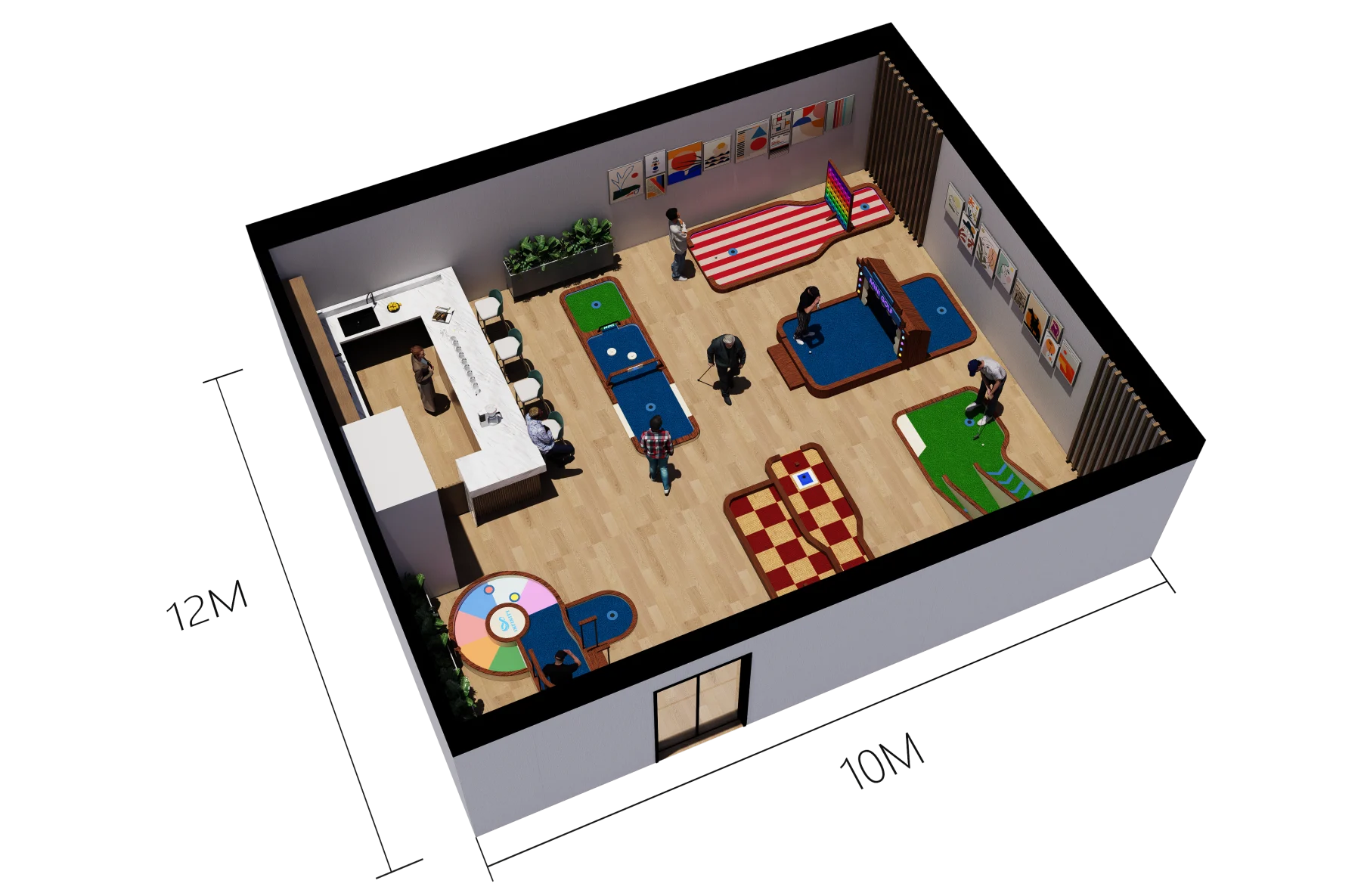
Product dimensions show the equipment footprint. A venue layout also needs to accommodate the people using it.
Walk through the plan as a group of visitors: where do they start, where do companions stand while the first player putts, which side do they leave from, and how do they reach the next hole? Then review it from a staff member's perspective, following the routes for cleaning, retrieving balls and maintenance.
Which positions deserve another look?
Check the relationships between putting, waiting and circulation areas. Two holes may fit separately on the plan but still interfere with one another when people use them at the same time.
Include columns, doorways and corners in that review. An empty patch on a drawing is not automatically useful activity space; its position and connections matter.
What is the trade-off between hole count and usable space?
When considering another hole, identify the space it would take and what changes for putting, waiting, circulation or maintenance.
This gives you a basis for comparing proposals. Counting holes alone can conceal differences in how the layouts would work.
If conflicts remain after adjusting the layout, discuss a different product combination, a revised playing order or a different quantity. Base the choice on the actual arrangement.
Does the course repeat the same playing task?
Ramps, obstacle routes, rebounds and target selection ask for different decisions. Write down the main task of each proposed hole, then check whether several require essentially the same action.
This helps distinguish a change of appearance from a change of gameplay. Equipment selection and layout need to be reviewed together; completing either one in isolation does not settle the final proposal.
Confirm what affects the physical product before manufacturing
A design entering production needs to move from visual presentation to requirements that can be manufactured and installed.
A rendering helps explain the theme, colours and overall appearance. You also need to understand the dimensions, structure, components and custom details of the supplied product, and how they relate to the venue plan.
| Item | Questions to resolve |
|---|---|
| Models and quantities | Which models have been chosen, and in which configurations? |
| Dimensions and footprint | Do the product dimensions match the final layout? |
| Appearance and custom details | Which colours, shapes and themed elements are confirmed? |
| Structure and components | How are obstacles, connections and assembly sections arranged? |
| Site installation conditions | How will equipment enter, and what preparation is required? |
| Supply and service scope | Which products, accessories and installation support are included, and what does the customer coordinate? |
Material descriptions should also relate to specific parts and configurations. If a surface, edge, obstacle or connection matters to your project, find its corresponding requirement in the proposal.
An omission to watch for is a mismatch between drawings, product configurations and site information. The appearance may have been revised while the layout still uses earlier dimensions, or site conditions may have changed without the production requirements being checked again.
When something changes, first identify what it affects. Changing a colour and changing a dimension involve different considerations; a dimension change also calls for another look at positioning and assembly space. Record the change in the same set of confirmed documents so everyone works from a shared basis.
Putt Infinity manufactures from the agreed design and keeps product requirements connected to the venue plan. The theme, gameplay and space conditions discussed at the start should continue through the project.
Prepare for installation early, then check how the course is used
Installation discussions should begin before the equipment arrives. Site readiness, access, team coordination and the order of work all affect the arrangements. Service methods can differ by location, so agree the scope of on-site installation or installation guidance in advance.
What should be checked before delivery?
Compare the actual venue with the final plan. Report changes to entrances, fixed fittings or reserved areas promptly rather than waiting until equipment is being positioned.
Also confirm the access route, installation sequence and work that requires your site team's participation. That clarifies where site preparation ends and equipment installation begins.
Why walk through a playing sequence after assembly?
Once the equipment is assembled, check putting, waiting and movement from the actual player positions, together with component fixing, connections and maintenance access.
The drawing and the experience of standing in the venue can inform one another. Describe any issue by its location: is a player position obstructed, does a neighbouring hole interfere, or is a particular part hard to reach?
Then identify whether the issue concerns positioning, a connection, user instructions or something else before discussing a remedy. A specific description is more useful than saying the installation does not feel right.
Putt Infinity provides installation support according to location and service arrangements. Agreeing the work and responsibilities early helps the customer coordinate the site.
Consider maintenance during design and keep following up after opening
Cleaning and maintenance deserve attention during design: where could dust collect, how will a stray ball be retrieved, can fixings be inspected, and can replaceable parts be reached?
There can be trade-offs with appearance. Themed decoration contributes to the visual experience while the design still needs usable access. Review both normal play and routine care when discussing the proposal.
After opening, keep the product configuration, final layout, installation information and component records together. They help both parties identify the equipment, position and configuration under discussion when a problem arises.
When contacting support, include:
- The product model and the affected component or position.
- When the problem occurs and what actually happens.
- Photos or video of the situation.
- Checks or actions already carried out.
Clear information helps troubleshooting and reduces repeated clarification of the same issue.
Putt Infinity supports care, troubleshooting and replacement-part enquiries for the equipment supplied. Future additions, theme changes or gameplay updates can also be discussed using the existing layout and product information.
Recommended products: compare three types of gameplay
If your equipment selection is still open, compare these three models. Start with what each asks the player to do, then consider themes and custom requirements.
Golf Parkour Hole
Read the route and negotiate ramps and obstacles
Golf Parkour Hole combines ramps, curves and obstacles. Players read the ball route and adjust shot direction and strength.
Consider how the changing route relates to its position in the venue and how play continues after a miss. If several selected holes already offer similar tasks, ask what this addition would do differently.
Use it as a reference for discussing a route-based hole, then refine the design around space, theme and colours.
View product details
Lucky Disc Golf Hole
Choose the route before taking the shot
The disc obstacle asks players to consider which side to pass and how to control direction and pace.
Assess it within the complete course: does its main task differ from the holes before and after it, and does it ask for another kind of route decision?
It can be considered alongside ramp and target holes when discussing a varied combination.
View product details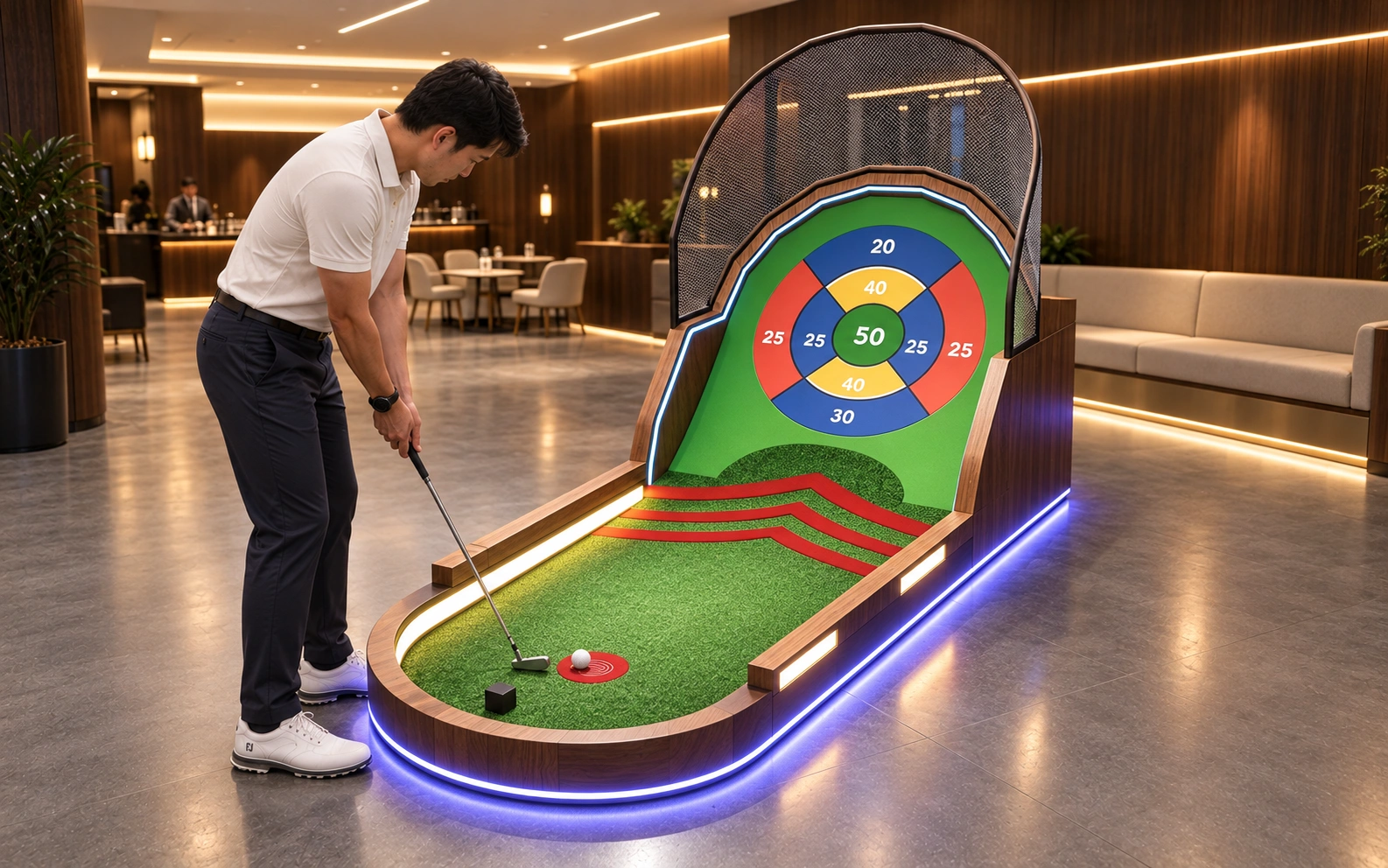
Golf Target Shooting Hole
Select a target, then control the shot
Golf Target Shooting Hole has several target areas. Players choose one and adjust their direction and shot strength to reach it.
If you want a clearly defined aiming task, explore this model and discuss how it could sit alongside route-based holes and where it would be positioned.
Confirm the final choice against the actual configuration, dimensions and venue layout.
View product detailsExisting models help compare gameplay and provide references for custom design. Which features you want to keep or change will shape the next design discussion.
Frequently asked questions
Can we start with the floor area but no floor plan?
You can begin by discussing the business format, theme and broad requirements. To assess quantities and layout, provide dimensions, entrances and fixed features. Venues with the same total area can still differ in shape and internal conditions.
Should we decide the number of holes first?
You can state a preference, but assess it against a layout. Putting, waiting, circulation and maintenance need space as well as the equipment. Compare what changes when holes are added or removed.
What if we only want one custom hole for an existing venue?
Start with its intended position, available dimensions and the gameplay you want to add. Also examine how it connects to the existing route and whether it repeats current holes, rather than choosing only by the size of an empty area.
Are reference images enough for a custom design brief?
Images help communicate themes, shapes and colours. Also explain which features you want to retain, what gameplay you want and the space limitations. Different people may value different parts of the same reference, so clarify that before design.
Can we approve manufacturing from a rendering alone?
Before production, also confirm dimensions, configurations, structure, custom details and installation conditions. The appearance shown in the rendering needs to correspond to these requirements. List unresolved items so both parties do not proceed with different assumptions.
Is installation included in the equipment quotation?
Check the specific quotation and service arrangements. Location, installation method and site participation affect responsibilities. Putt Infinity provides installation support; agree its scope before the equipment arrives.
How do we contact you about a fault or a gameplay update after opening?
For an equipment issue, provide the model, affected position, a description and photos or video. For additional holes, a theme change or a gameplay update, share the existing layout and your ideas so the discussion can start from the equipment and space already in place.
Start with the information you already have
You do not need to select every product before getting in touch.
For one custom hole, share dimensions, reference images and gameplay ideas. For a complete venue, send the floor plan, project location and intended business format. Separating confirmed conditions from open questions helps decisions progress step by step.
Putt Infinity works with you on hole design, venue planning and equipment manufacturing, coordinates installation support and provides maintenance support after the course enters use. Send us your idea or floor plan, and start with the issue you need to resolve first.
Discuss a custom hole or a complete indoor mini golf project with Putt Infinity.