By: Puttinfinity TeamPublished:
COURSE DESIGN & OPERATIONS
Interactive Mini Golf Scoring Systems: Points vs Strokes
Choose a scoring approach, compare its equipment and operating requirements, and prepare a brief for a new venue or an existing-course upgrade.
Start with strokes when your main objective is a clear putting competition. Explore reward points or a hybrid when target hits and other achievements are part of the attraction. For mixed-experience groups, first test whether guests understand how to score and when a hole ends.
There are two decisions: what the game rewards, and how the system records it. Strokes reward fewer attempts to finish; reward points follow a published table or achievement rule; a hybrid combines objectives. Any of these may involve manual entry, automatic detection or both.
1. Which scoring format should your venue evaluate?
Use your main guest experience to narrow the options. These are starting points for evaluation; the table does not rank measured business performance.
| Your priority | Start by evaluating | What must be clear? |
|---|---|---|
| Putting practice or competition | Transparent stroke scoring: the lowest total wins. | How strokes, penalties, unfinished holes and ties are handled. |
| Interactive targets and themed challenges | Target points or a hybrid that gives those achievements an explicit value. | Which events earn points, how they are recorded and whether extra attempts are allowed. |
| Mixed-age or mixed-experience family groups | The simplest rule that expresses your intended game; add bonus rules only when guests can explain them. | Can a first-time guest explain the score and stopping rule after one hole? |
| Several activities, leagues or team events | Published rules for each activity; assess mode switching if required. | Actual supported modes, staff steps, team-size rules and separate comparable leaderboards. |
For team play, specify how team size and contributions affect the result. Compare leaderboard scores only within the same course, mode and rules version.
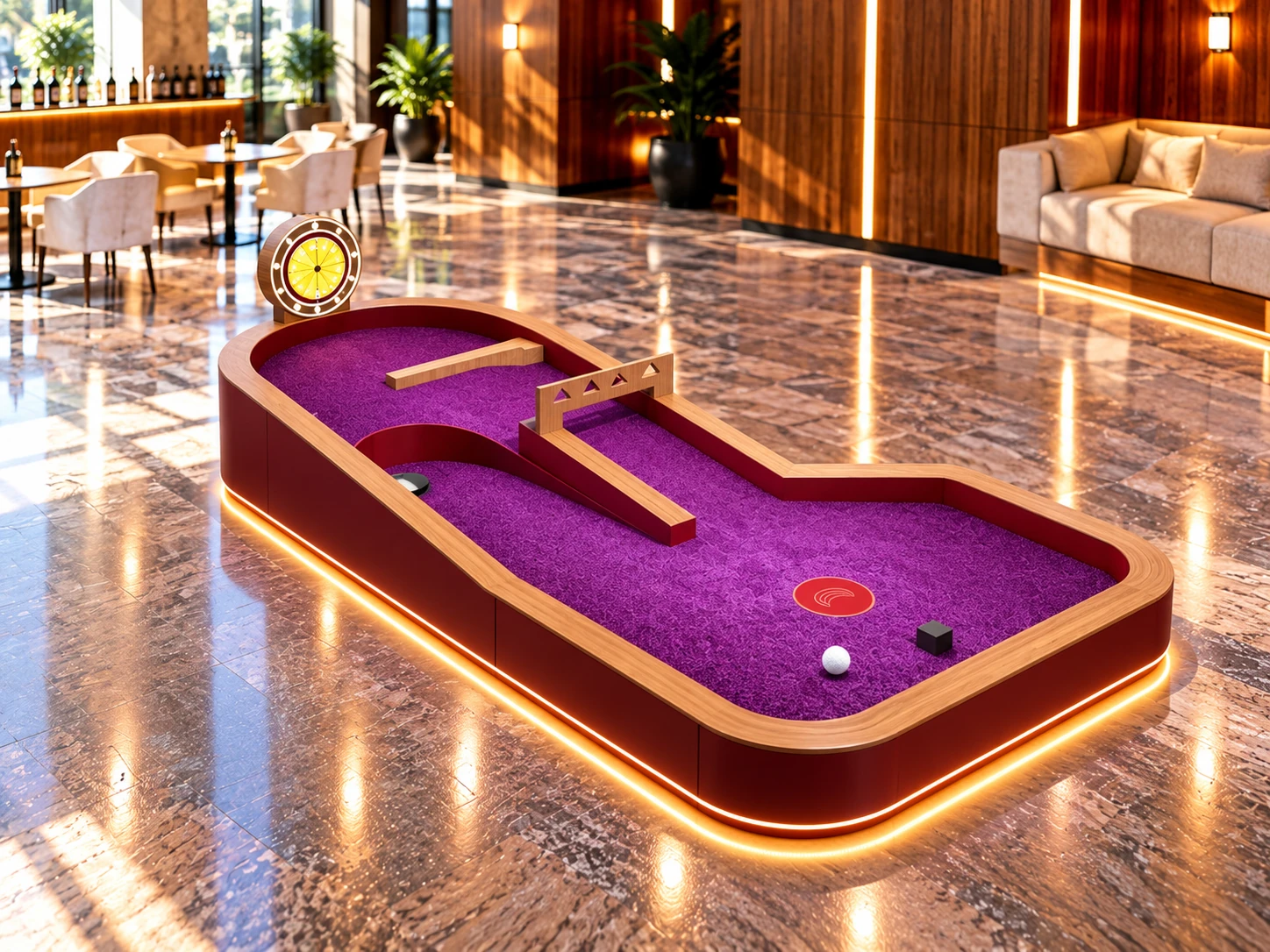
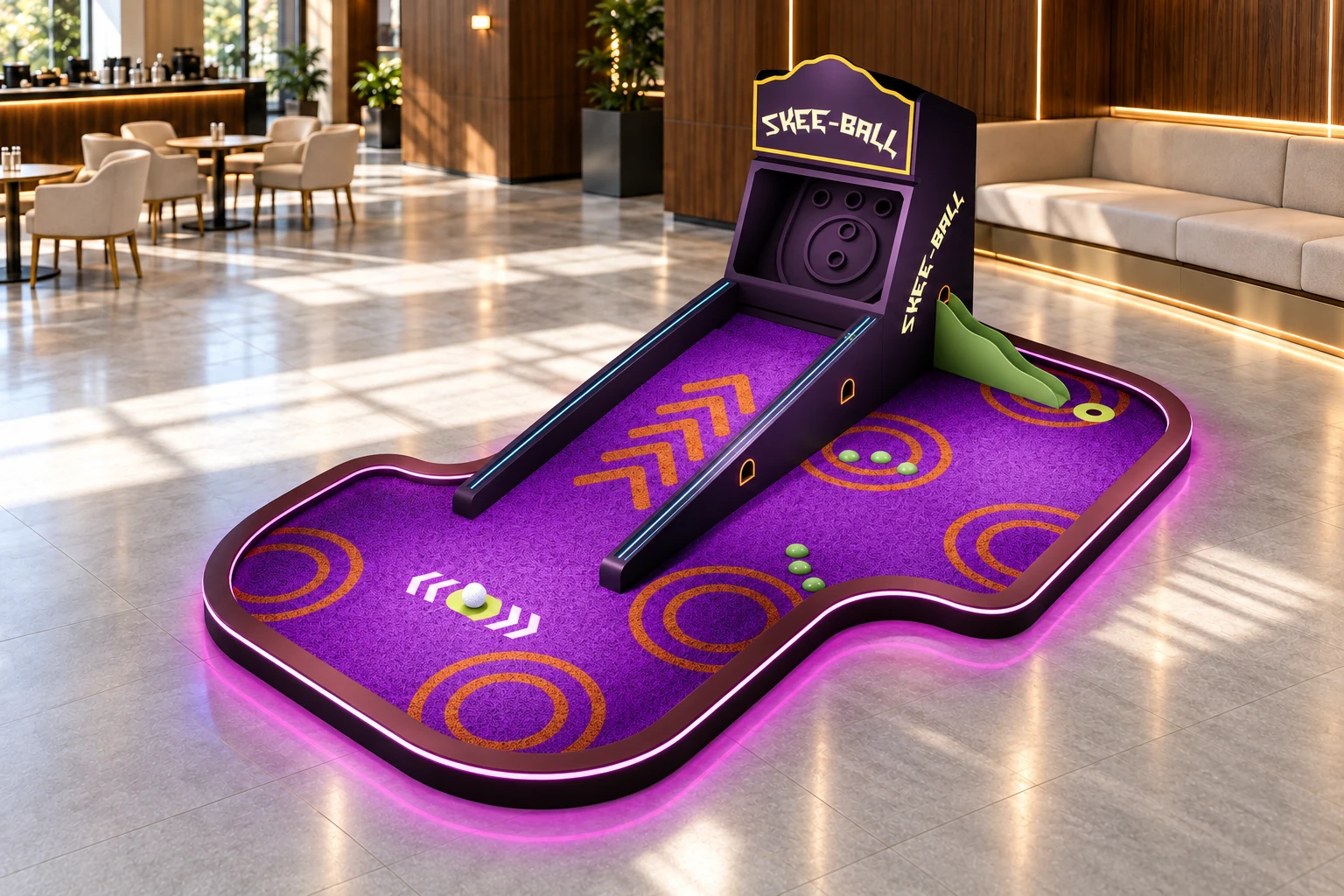
2. What changes when you switch from strokes to points?
A different scale can preserve the same winner. If every completed hole earns 10 − strokes, nine holes produce 90 − total strokes. The lower stroke total becomes the higher points total. This holds when everyone plays the same scored holes, each stroke has the same positive weight, and penalties and unfinished holes are treated consistently.
A floor or bonus can change what wins. A rule that limits the damage from a difficult hole, or rewards targets separately, values performances differently. A venue must decide how much putting efficiency, exceptional holes and extra achievements should matter.
Puttshack supplies an attributed commercial example: its December 2023 guide awards 50 points for one shot and 40 for two, with bonuses and hazards; its game page describes proprietary automatic ball tracking. These are that operator’s published mechanics, not Putt Infinity specifications. [3] [4]
The same round can produce a different winner
Designed teaching example: Player A completes nine holes in two strokes each. Player B makes seven holes in one and holes out in six strokes on each of the other two. All holes are completed; there are no handicaps or extra penalties. A target of two strokes per hole is assumed for the clipped-points example.
| Player | Stroke total Lower wins |
10 − strokes per hole Higher wins |
max(0, 4 − strokes) per hole Higher wins |
|---|---|---|---|
| A: nine 2s | 18 | 72 | 18 |
| B: seven 1s, two 6s | 19 | 71 | 21 |
The reversal has a specific cause. In the clipped system, four and six strokes both earn zero, so B’s difficult holes cannot cancel as many of the points from the seven excellent holes. The system rewards the distribution of performance differently.
This does not establish that B’s win is fairer or more enjoyable. It gives an operator a clear choice: emphasize overall consistency, reward exceptional holes, reward target achievements, or publish a combination.
3. What does the scoring system actually record?
A screen can calculate scores entered by a player without detecting any shots. A cup sensor can confirm a finish without establishing every earlier stroke. Ask for the complete path from a player’s action to the displayed result, using the configuration proposed for your venue.
| Requirement | Evidence to request |
|---|---|
| Stroke totals | Identify which strokes are detected and which are entered manually; demonstrate player and hole assignment. |
| Target or bonus points | Show each eligible event, repeat limits, deductions and the explanation visible to the guest. |
| Modes, membership and rankings | Show the supported configuration, any integration requirements, and how scores from different rules remain separate. |
| Staff control and recovery | Demonstrate correction permissions, score history, resets and the actual behavior during a connection interruption. |
4. What should a scoring-system quotation include?
Compare the same hole count, recorded events and installation scope. A points format does not cost more simply because it displays larger numbers: equipment, integration and service requirements determine the scope.
| Quote category | Ask the supplier to specify |
|---|---|
| Equipment | Course and scoring hardware, detected events, displays, controllers, networking and replacement or spare equipment. |
| Installation and launch | Site work, wiring, calibration, commissioning and training; identify responsibilities and exclusions. |
| Software and recurring charges | Licence basis and period, renewals, updates, optional integrations and any usage-based charges; what changes if a subscription ends. |
| Maintenance and changes | Wear parts, repairs, remote and on-site support, warranty terms, and the work needed to change a game or expand the course. |
| Quotation assumptions | Location, date, included configuration, delivery and tax treatment, exclusions and project-specific conditions. |
5. What should you see in a practical demonstration?
Follow a normal hole from player assignment to the final score, then check the situations that would bring a guest to the front desk. Record what the guest sees and what the employee must do.
| Situation to check | What to establish |
|---|---|
| Missed event or wrong player | How it is discovered, who corrects it and whether other players’ scores are affected. |
| Duplicate target signal | How repeated signals and legitimate repeat actions are distinguished under the published rule. |
| Connection loss or restart | What happens to the session and scores; how play resumes and what requires staff intervention. |
| A disputed score | Where staff inspect the result, edit it with the appropriate permission and review the correction record. |
Upgrading an existing course?
Assess the hole and cup structures, device locations, power, network conditions, and installation and commissioning arrangements before assuming a retrofit is straightforward. Ask which changes require physical work and how installation will be coordinated with trading hours. Provide current scoring methods and photos or a plan if available.
6. What would a hybrid rule look like to a guest?
A bowling-style hole can reward both completion and eligible pin hits. The following is an unimplemented design example; its rules and display are not an installed Putt Infinity product specification.
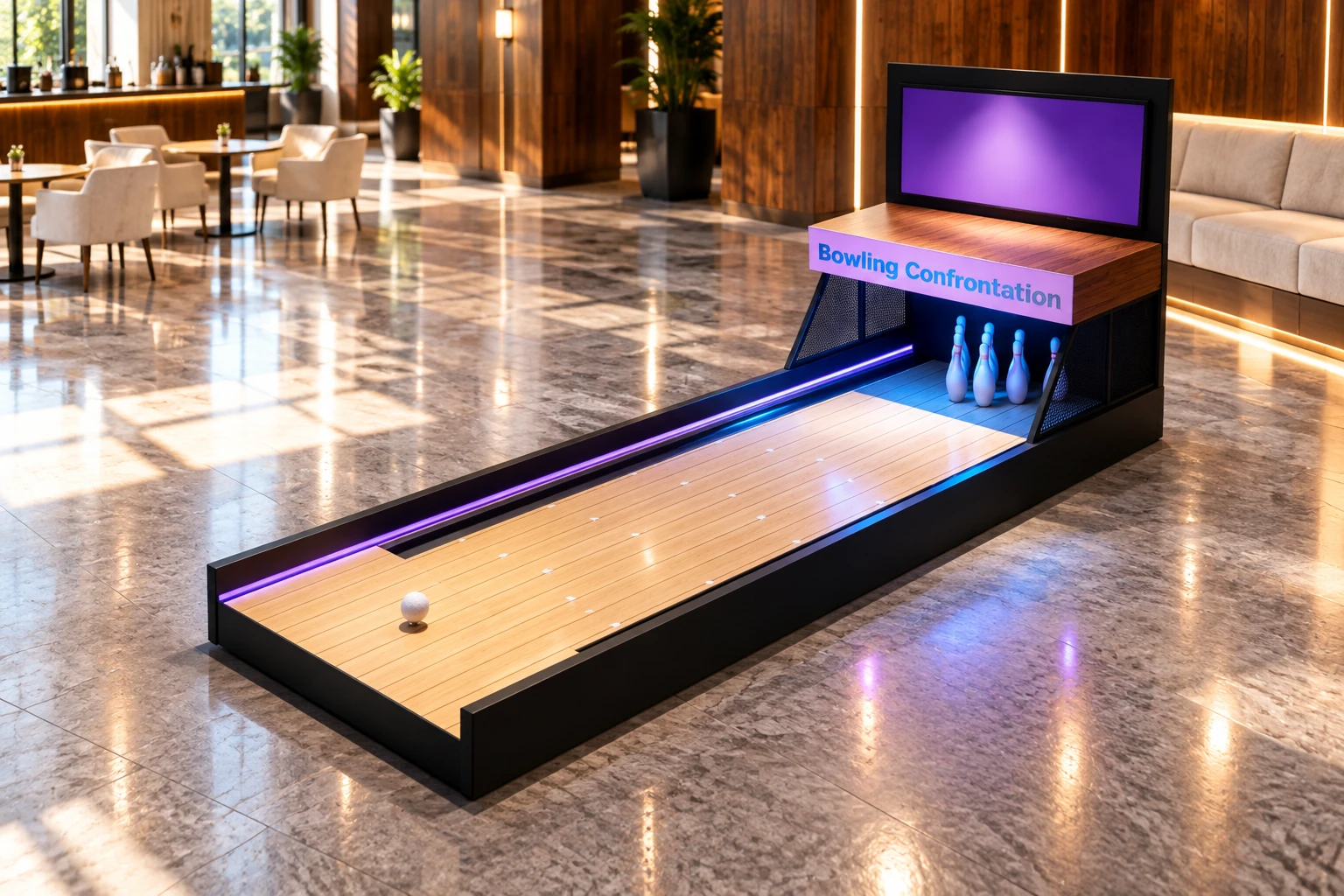
A guest-facing rule for this example
Finish in fewer attempts for more completion points. Earn 10 points per distinct eligible pin, up to 30 bonus points. Your turn ends when you hole out, reach six attempts or choose to stop; you cannot continue afterwards.
TWO-STROKE FINISH
90 points
- Completion
- 90
- Eligible pins
- 0 × 10 = 0
- Total
- 90 + 0 = 90
FOUR-STROKE FINISH
100 points
- Completion
- 70
- Eligible pins
- 3 × 10 = 30
- Total
- 70 + 30 = 100
Calculation: completion points are 100 − 10 × (s − 1) for holing out in attempts 1–6, otherwise zero. Add min(30, 10 × K), where K counts distinct eligible pins credited once during the player’s hole.
Stopping early is final: keep earned pin points, receive zero completion points and take no further attempts. A completed hole scores at least 50; an unfinished one at most 30. Before using this rule, establish detectable pins, player attribution, final-shot event handling, duplicate rejection, staff corrections and resets between players. This example permits shared positions for ties. Pursuing bonuses can add attempts, so shorter rounds must not be assumed.
7. What should you validate before purchase and after opening?
Before purchase: use the proposed configuration to check scoring, guest explanations, manual steps and recovery. Agree the demonstration and acceptance conditions for your project. A new venue does not need existing replay data to start this discussion.
After opening: compare modes under comparable course, group-size and operating conditions. Where practical, allocate modes consistently or randomly; if guests try both, vary the order to reduce learning effects.
| Measure | Useful definition |
|---|---|
| Rule understanding | Guests who correctly explain scoring and stopping divided by guests asked. |
| Operational effort | Staff assistance time, reasons for intervention, reset work and corrected player-hole scores divided by audited player-hole scores. |
| Round duration | Median and 90th percentile, with group size, technical faults and operating conditions recorded. |
| Experience and replay | Consistent enjoyment and clarity questions; actual paid replay or defined later bookings kept separate from stated intention. |
Correction rate is not detection accuracy: errors that nobody notices or corrects can remain. Any accuracy claim needs an audit of missed, false and wrongly assigned events. Set criteria and a suitable sample plan before drawing conclusions.
Motivation research offers reasons to test feedback, choice and social experience; it does not establish a mini-golf revenue or throughput gain. A higher points total alone proves only that the scoring result changed. Read the evidence and its limits.
Frequently asked questions
Does electronic scoring automatically count every stroke?
No. Electronic scoring may calculate manually entered scores, detect a finish, or identify more events. Ask which strokes and targets the quoted configuration detects, how it assigns them to a player, and which inputs remain manual.
Can an existing mini golf course be upgraded?
Assess the actual course and proposed equipment first. Share hole and cup details, available power and network information, current scoring methods and photos or a plan. Confirm physical alterations and installation arrangements before agreeing the scope.
Can a system support both strokes and points?
Both formats can be designed, but a particular system must support the required rules and inputs. Confirm mode selection, staff steps and separate leaderboards. For beginners, test rule understanding rather than assuming that points are always easier.
How are missed, duplicate or wrongly assigned scores handled?
Request a demonstration of detection, correction permissions, score history and session recovery. Confirm what happens during an interruption and how guests continue. Offline operation and automatic error recovery must be established for the actual configuration.
What will staff need to do during busy periods?
Check starting sessions, assigning players, explaining rules, resolving disputes and resetting holes. Record these steps during a demonstration and later during real visits. Automatic recording alone does not establish lower staffing needs or faster full rounds.
What costs should be included beyond the initial installation?
Ask about software renewals, updates, integrations, support, maintenance and replacement parts, including the charging basis and exclusions. Use the indoor mini golf project cost guide to extend the budget discussion beyond scoring.
What should I ask to see in a scoring-system demonstration?
Use the configuration named in the proposal. Follow a normal hole, trigger an eligible target if relevant, inspect a correction and establish interruption recovery. Have a first-time player explain the rule. A final floor plan is helpful when available; an outline of your project is enough to begin defining requirements.
PLAN THE SCORING WITH YOUR COURSE
Discuss the scoring requirements for your venue
Tell Putt Infinity about the experience you want to create. Start with the information you have; include a floor plan and budget range if available.
- Your project: location, new venue or upgrade, approximate playing area or planned hole count.
- Your guests: main groups, preferred experience and any team or competition requirements.
- Your priorities: scoring approach, events to record, staff workflow and target opening or installation date.
- Your proposal questions: demonstrated capabilities, manual steps, installation scope, recurring charges and support.
Discuss your project on WhatsAppDownload the blank scoring brief
A completed brief is optional. If you use it, leave undecided items as “not yet known” and bring it into your project discussion.
Rules and research behind this guide
The following references support the rule explanations and design questions above. They provide context for decisions; project-specific performance requires its own evidence.
Official minigolf rules and the meaning of points
The German federation’s January 2026 edition of the WMF international sport rules counts each stroke as one point. If a player has not reached the target after six strokes, one more point is added, producing a lane score of seven. The lowest aggregate wins in stroke-count competition. Electronic scorecards are permitted under the scoring-record rules. Separate disciplinary penalties remain relevant. [1]
This terminology matters: the word points can describe a lower-is-better stroke count. In this guide, reward points means a higher-is-better score.
A recreational venue should publish its own applicable house rules. Do not advertise a bespoke attraction as tournament compliant merely because it counts strokes. Clearly distinguish holing out on the sixth stroke from failing to finish after six attempts.
Stableford: a golf reference for target-relative points
Golf’s standard Stableford is a form of stroke play. Under R&A Rule 21.1, points depend on strokes relative to a fixed target, normally par. Matching the target earns two points; one over earns one; two or more over, or not holing out, earns zero. The highest total wins. [2]
Standard Stableford encourages stopping when the hole can only produce zero points. A recreational mini-golf adaptation needs its own published stopping rule and should be labelled Stableford-style rather than presented as the universal minigolf rule. [2]
What motivation research actually supports
Self-determination theory distinguishes competence, autonomy and relatedness: feeling capable, having meaningful choice and feeling connected to others. [5] For course design, these suggest questions worth testing: does feedback explain progress, can guests choose a suitable challenge, and can a group celebrate a shared result? These are design interpretations, not proven mini-golf outcomes.
Mekler and colleagues’ image-annotation experiment found greater output with points, levels and leaderboards without a significant improvement in intrinsic motivation or perceived competence. Doing more and enjoying an activity more are different outcomes. [6]
Sailer and colleagues studied an online warehouse simulation. Of 419 completers, 331 entered the analysis after treatment checks. All conditions included points. The added badges, leaderboard and performance graphs produced a significantly higher competence rating than control; the other bundle’s competence comparison with control was not significant. [7]
| Condition | Analyzed n | Mean | SD |
|---|---|---|---|
| Points only | 150 | 3.76 | 1.36 |
| Points + feedback bundle | 103 | 4.19 | 1.35 |
| Points + social/story bundle | 78 | 4.10 | 1.47 |
These findings concern digital tasks, including bundled features and analysis exclusions. They do not establish higher mini-golf satisfaction, faster rounds, repeat bookings or revenue. Mini golf is already a game; adding game elements to another task is an adjacent research context.
Sources and methodology
Governing-body publications support the rule explanations. Peer-reviewed studies provide adjacent design evidence. Operator pages establish their own published examples. All worked scoring examples and procurement recommendations are original editorial analysis. Sources were checked on 5 November 2026.
- DMV, Internationale Spielregeln, January 2026. Official German edition of WMF §2.3; §§9, 10(12) and 18. Return to rules.
- The R&A, Rules of Golf, Rule 21.1. Stableford definition and scoring. Return to formats.
- Puttshack, 9-Hole Scoring, 26 December 2023. Dated operator-specific example.
- Puttshack, The Game. Operator’s own account of its tracking system; no independently verified performance claim is inferred.
- Ryan, R. M., & Deci, E. L. (2000). Self-determination theory and the facilitation of intrinsic motivation, social development, and well-being. American Psychologist, 55(1), 68–78. DOI.
- Mekler, E. D., Brühlmann, F., Tuch, A. N., & Opwis, K. (2017). Towards understanding the effects of individual gamification elements on intrinsic motivation and performance. Computers in Human Behavior, 71, 525–534. DOI. Qualitative findings verified from the institutional abstract.
- Sailer, M., Hense, J. U., Mayr, S. K., & Mandl, H. (2017). How gamification motivates. Computers in Human Behavior, 69, 371–380; Table 3, p. 377. Institutional record; author-uploaded full text.
Putt Infinity project-option wording is based on company-provided information about optional scoring, membership-linked features and player rankings. Included capabilities remain subject to the project configuration and quotation; this is not independent product testing.