OPERATOR’S FIELD GUIDE / COST PLANNING & PROCUREMENT
Indoor Mini Golf Cost Breakdown: What Buyers Should Budget For
A practical, evidence-backed framework for equipment, course design, site preparation, logistics and long-term expenses—without made-up supplier prices.
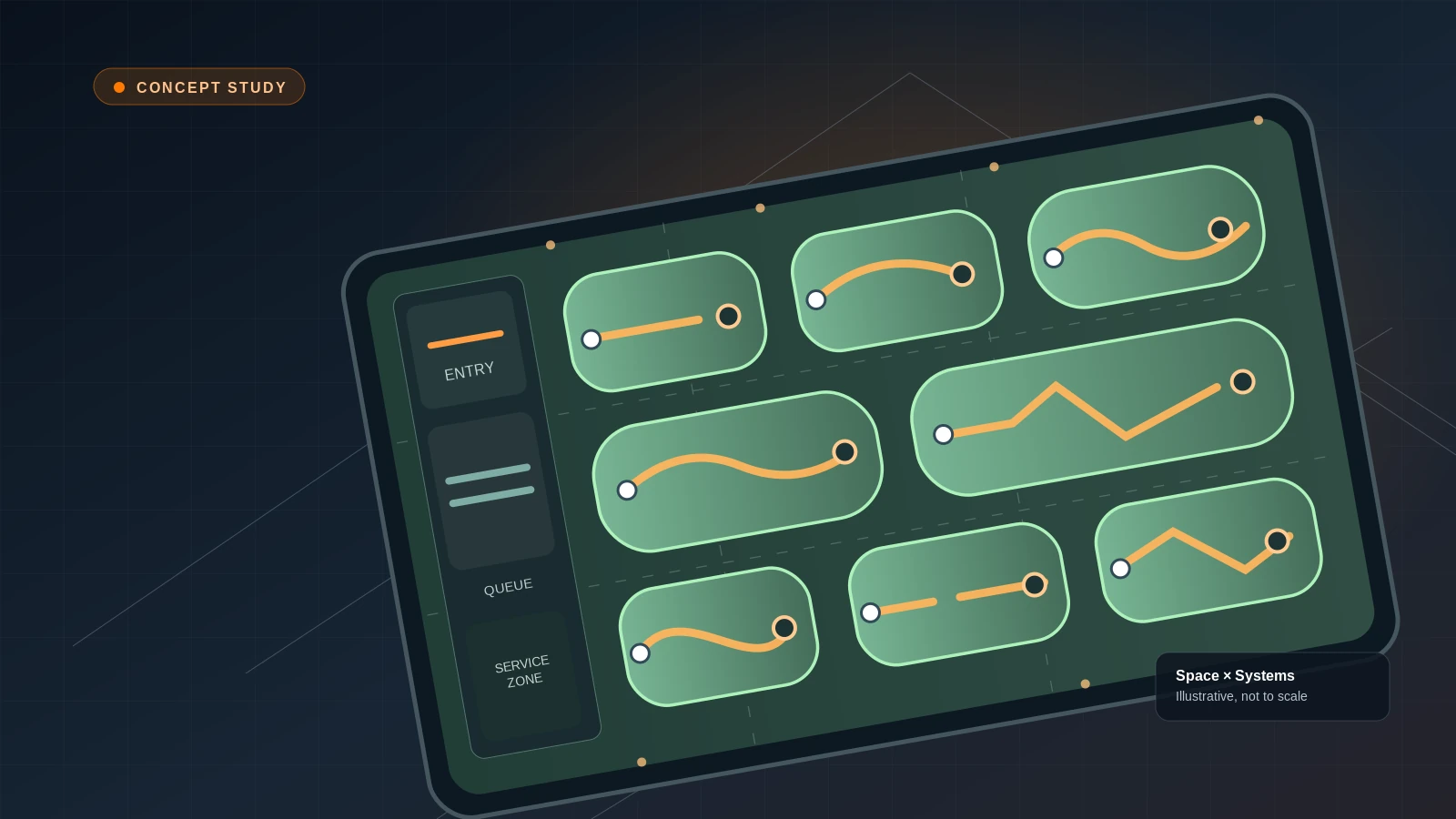
Indoor mini golf does not have one defensible universal price. Buyers should budget separately for design, putting equipment, themes and electronics, site work, shipping, installation, approvals, and operating cash. An itemized scope and site-specific quotations matter more than a headline “cost per hole.”
View the full cost matrixFor a family entertainment center, shopping mall, bar, or stand-alone attraction, the question “How much does an indoor mini golf course cost?” is reasonable—but incomplete. A physical course is only one part of a commercial venue. Building requirements, the customer experience, logistics, and long-term operations all affect the amount of money an operator may need.
Two venues with the same number of holes may have different financial requirements because they use different obstacle mechanisms, electrical systems, themes, or building infrastructure. Even the meaning of a supplier’s quoted price can vary: a factory equipment price is not the same as a delivered and commissioned attraction.
This guide uses a scope-first, evidence-based approach to help buyers identify cost categories, compare offers, build their own assumptions, and estimate the implications of visitor demand. It does not publish “average market prices” without independently verified market pricing data.
What is included in the total indoor mini golf budget?
A project budget is not a single supplier invoice. A more useful structure starts with distinct layers of cost: procurement, delivered equipment, installed project, opening capital, and cash needed to operate the business. The U.S. Small Business Administration’s business-planning guidance encourages entrepreneurs to examine startup costs as part of a broader financial plan. [1]
Indoor mini golf cost breakdown matrix
Please share your floor plan and requirements with our team.
Ask for a tailored estimate| Category | What to include | Evidence to request |
|---|---|---|
| Design & planning | Concept drawings, dimensions, layout revisions, technical coordination | Defined deliverables and revision terms |
| Putting equipment | Playing surfaces, structures, obstacles, cups, accessories | Per-hole specifications and quantities |
| Theme & interaction | Custom fabrication, LEDs, sensors, controls, scoring | Hardware / software bill of materials |
| Venue preparation | Flooring, electrical distribution, accessible paths, any renovation | Local site survey and contractor scope |
| Delivery & import | Packing, freight, insurance, duties, broker and handling fees | Incoterm, named place, freight and customs estimates |
| Installation & handover | Assembly, electrical integration, testing, training | Responsibility matrix and acceptance protocol |
| Opening & operation | Permits, staffing, utilities, rent, maintenance, spare parts | Local operating plan and supplier maintenance terms |
Before comparing supplier totals, compare their scope of supply. What one vendor bundles into equipment may be optional, excluded, or locally procured in another quote.
Course design, floor area and site readiness
Floor area is a starting constraint—not a reliable price multiplier. A rectangular room with clear circulation can support a different course design from a similarly sized room interrupted by columns, doors, raised thresholds, or protected exit routes. A layout should account for the entire operating sequence from entrance to the final hole.
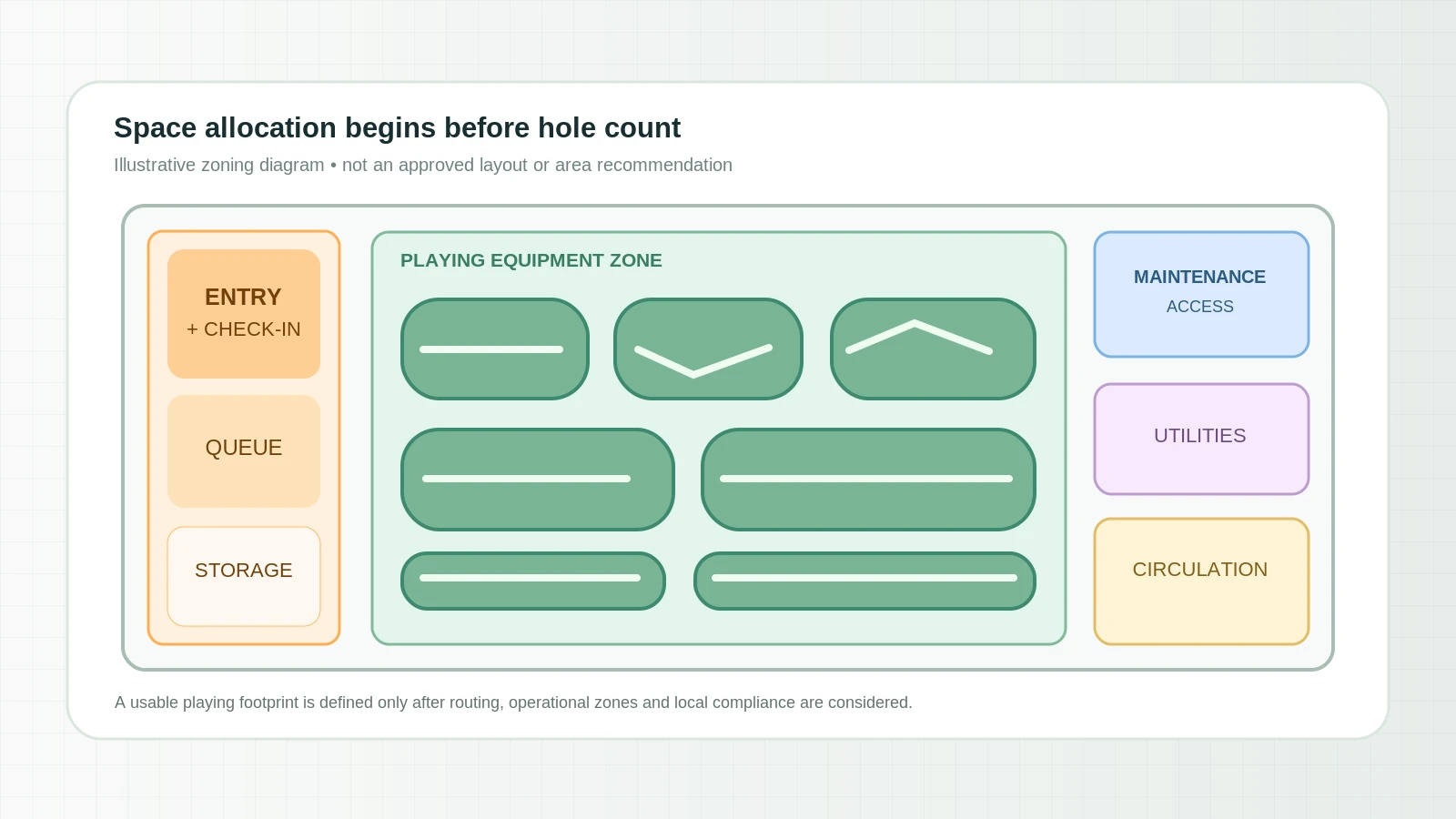
Gross floor area is not usable playing area
The published floor area of a property may include reception, queuing, restrooms, storage, utility rooms, seating, and circulation. Course equipment cannot automatically occupy all of it. Ask for a dimensioned plan that identifies fixed building elements, maintenance access, and the space needed around each hole. The goal is not to maximize hole count at all costs, but to establish a workable experience and safe flow.
Standard configurations versus customized layouts
Standard products may reduce bespoke design work when they fit the site. Custom layouts may require changed playing geometry, obstacle engineering, artwork, and additional approval cycles. These are cost drivers, not universal price multipliers: the final effect depends on manufacturing requirements and the agreed design scope.
Accessibility and local permissions
For projects subject to U.S. ADA requirements, the U.S. Access Board specifies that at least 50% of miniature golf holes must comply with the accessible-hole requirements, and those compliant holes generally must be consecutive, subject to a specified exception. The detailed technical requirements cover start-of-play areas and routes, among other elements. [2] That percentage is a U.S. accessibility rule, not a cost statistic. Other countries and jurisdictions have their own requirements; local professionals should confirm applicable approvals.
Dimensioned floor plan, equipment positioning, visitor flow, utilities interfaces, and the assumed scope of revisions.
Accessibility, fire and egress provisions, building use, electrical requirements, and structural conditions as applicable.
Mini golf equipment costs: what to include in your quote
Request an itemized quote for the five groups below. Hole dimensions, materials, selected mechanisms and the agreed supply scope matter more than a single cost-per-hole figure.
- Basic lanes
- Playing surfaces, frames, edges and cups. Confirm dimensions, materials and assembly for each hole.
- Obstacles
- Fixed and moving obstacles. Specify mechanisms, guards, service access and replacement parts.
- Interactive equipment
- Sensors, controllers and scoring where selected. Confirm power, wiring, calibration, software rights and support.
- Lighting & decoration
- LED lighting, props and themed finishes. Separate equipment decoration from venue fit-out and confirm any recurring services.
- Accessories
- Putters, balls, spare cups and service tools. State quantities and the initial spare-parts allowance.
Which configuration fits your customers?
These are planning directions, not fixed-price packages. Final inclusions, installation and any ongoing fees must be confirmed in the quotation.
- Standard
- For compact venues and first-time operators prioritizing straightforward operation. Start with basic lanes and fixed obstacles; keep bespoke mechanisms and themed construction limited.
- Interactive
- For family entertainment centers, bars and operators seeking varied challenges and repeat play. Select interactive features hole by hole and plan power, commissioning and technical support.
- Premium themed
- For destination venues, hotels and brands seeking a coordinated visual identity. Combine a tailored layout, custom obstacles, lighting and finishes; allow for design approvals and site coordination.
Our products and 3D design references

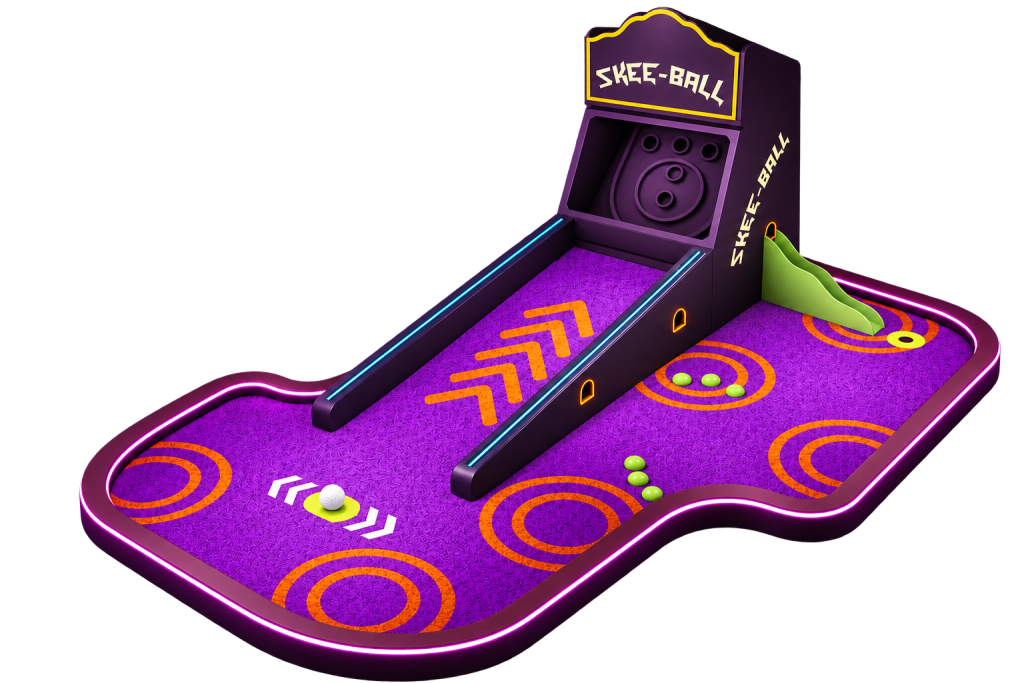
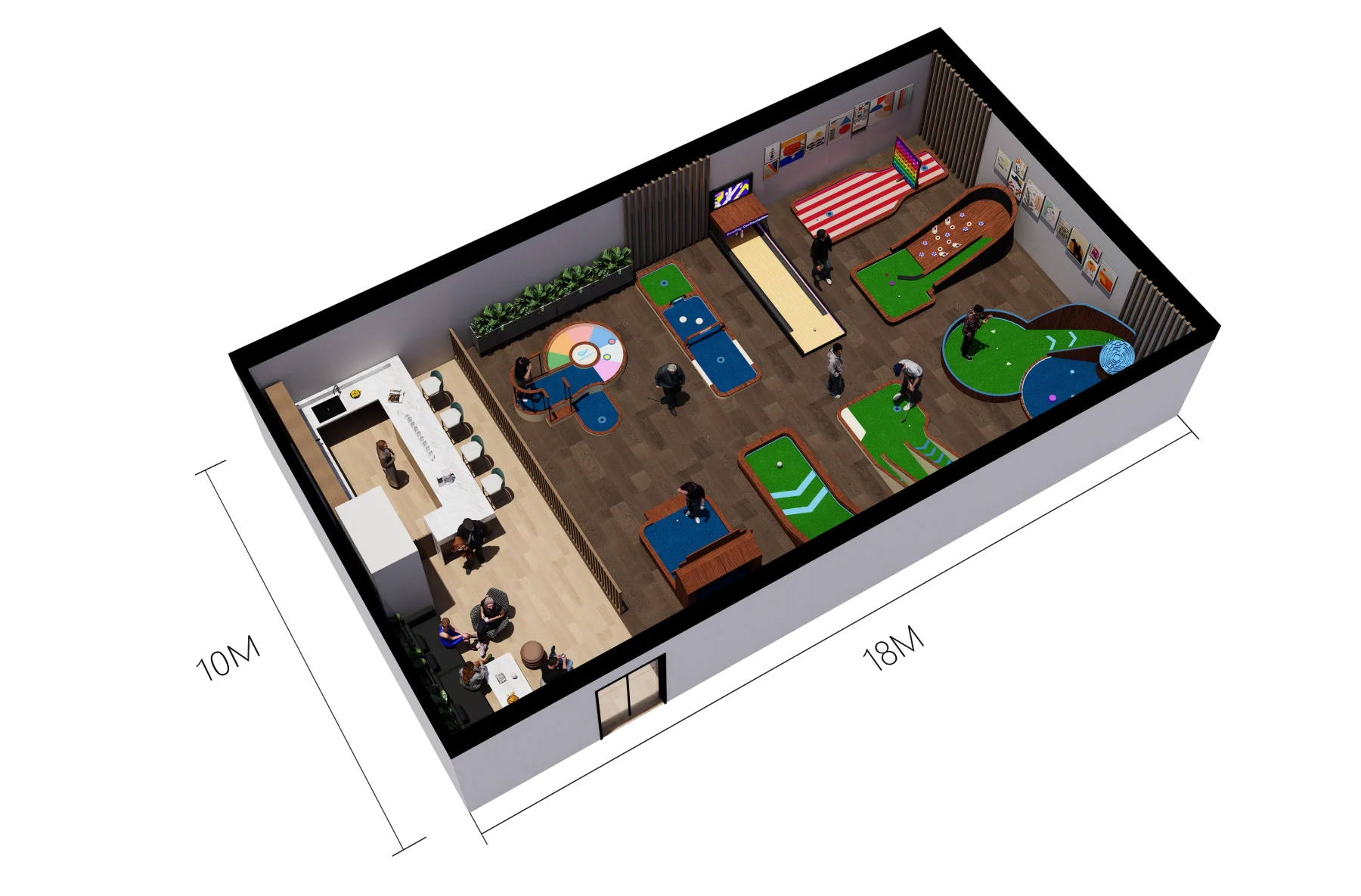
Request an equipment quote
Enter all three details, then add your contact information in the project inquiry form. The final quotation depends on the confirmed design and supply scope.
Browse products, discuss a free 3D layout and compare venue solutions before finalizing the equipment list.
Durability is a lifecycle consideration
Surface finish, frequency of use, accessibility of wear parts, and the availability of replacements can affect maintenance requirements. Rather than accepting phrases such as “industrial grade” or “maintenance-free,” ask the supplier to identify materials, applicable test information, warranty exclusions, replacement intervals where specified, and instructions for inspection.
A procurement schedule should also name supporting accessories such as putters, balls, replacement cups, and any required ball-return equipment. A quotation may cover only the core course structures unless accessories are stated explicitly.
Custom theming, lighting and digital scoring systems
Entertainment venues often combine play with visual identity. Custom artwork, themed facades, sound, LED lighting, mechanical motion, and digital scoring should be considered distinct technical and commercial packages even when they are presented as one experience.
Separate hardware, software and ongoing services
An electronic scoring option may require sensors, controllers, local networking, display hardware, software rights, configuration, and support. Ask whether the quotation covers installation and calibration, how downtime is handled, who owns player information, and whether hosting or licensing is charged on a recurring basis. Do not assume every device needs cloud connectivity or that every supplier uses a subscription.
Electrical efficiency should be modeled, not guessed
For lighting and other powered equipment, request measured or specified demand rather than estimating energy costs from fixture count alone. The U.S. Department of Energy’s LED efficiency guidance describes the difference between LED package and complete-luminaire performance, helping explain why product-level data matters. [3]
The most useful feature comparison is not simply “manual versus automatic.” It is a written comparison of what the system does, which equipment makes that possible, and which tasks remain with the operator.
Freight, imports, assembly and acceptance testing
A quotation that ends at the factory gate cannot be compared directly with an offer that includes delivery and commissioning. The U.S. International Trade Administration describes landed cost as the total price including relevant freight, insurance, tariffs, taxes, and other fees. [4]
Read the Incoterm and named destination
ICC Incoterms® 2020 allocates specified delivery obligations, costs, and risk between the buyer and seller. Its rules do not automatically specify who installs mini golf equipment, commissions interactive devices, or modifies the building. [5] Confirm the actual chosen term, named place, loading and unloading arrangements, importer obligations, and local delivery access.
Define installation completion
Delivered equipment may still require structural positioning, mechanical assembly, electrical connection, control programming, sensor calibration, gameplay testing, training, and documentation. A written acceptance protocol should identify the observable conditions needed for handover. Warranty responsibility, shipping damage, site-related defects, and later wear should not be left ambiguous.
Packing list→02
Delivery terms→03
Site installation→04
Acceptance
Who should quote each part of the project?
Credible procurement estimates rely on assigning each cost to a party with the information and capability to price it. A manufacturer may know the scope of its own equipment, but it cannot necessarily determine the buyer’s local building approvals or import taxes without additional information. Likewise, a local contractor may need manufacturer drawings before quoting electrical connections or structural interfaces.
| Cost area | Information source | What the buyer must check |
|---|---|---|
| Equipment and supplied controls | Equipment supplier | Final quantities, drawings, exclusions and warranty |
| Building and electrical changes | Qualified local consultants / contractors | Site conditions, permits and interface specifications |
| Freight and imports | Forwarder, customs broker and authorities | Shipment data, duties and named delivery place |
| Installation and commissioning | Contracted installation party | Assembly, safety testing, training and sign-off |
| Venue operations | Business owner and local service providers | Rent, labor, energy, insurance and realistic demand |
When several parties share responsibilities, maintain a matrix stating who supplies, installs, inspects and pays for each package. This can prevent omissions and make design changes easier to track. Do not assume that a supplier’s estimate automatically includes third-party services simply because they are necessary for the completed attraction.
Recurring operating costs and equipment lifetime
Buyers who focus only on acquisition costs risk overlooking the resources needed to operate the venue. Recurring financial requirements may include labor, rent, utilities, cleaning, routine servicing, high-wear replacements, insurance, marketing, and paid software services if applicable.
The NIST Building Life Cycle Cost User Guide (2025) documents a broader method for examining capital and recurring costs over time. It is not a miniature golf price database; its usefulness here is methodological. [6]
Three costs to investigate early
Maintenance access
Can a technician inspect and replace likely wear components or electronic modules without dismantling an entire themed installation?
Recurring digital services
Which functions depend on subscriptions, cloud hosting, third-party software, or periodic technical visits? Which are optional?
Operational staffing
How much front-of-house supervision, guest support, cleaning, and equipment checking is needed for the planned operating model?
Revenue or labor-saving promises should be evaluated against actual workflows, demonstrable functionality, and documented assumptions rather than treated as inevitable benefits of automation.
How to develop a cost estimate without inventing prices
The U.S. Government Accountability Office’s Cost Estimating and Assessment Guide outlines practices including scope definition, work breakdown structures, documenting assumptions, risk analysis, and updating estimates. The guidance is general—not mini golf industry pricing—and these principles can be adapted to private attraction projects. [7]
Similarly, RICS New Rules of Measurement offers recognized approaches to organizing construction estimates and cost plans. It helps frame venue fit-out discussions but is not a quotation for entertainment equipment. [8]
- Define the project boundary. State venue location, intended attraction, the usable floor plan, required features and exclusions.
- Build a work breakdown structure. Separate design, equipment, site work, logistics, installation and opening expenses; prevent double counting.
- Record evidence quality. Label each number as an assumption, indicative estimate, itemized quote, or contracted amount.
- Assign cost ownership. Identify which costs belong to the supplier, local contractors, freight provider, broker, or operator.
- Account for uncertainty. Keep a risk register and estimate contingency in relation to identified risks, not an unexplained universal percentage.
- Revise as evidence improves. A defensible early budget is a documented range or set of assumptions, not a false-precision price tag.
| Evidence stage | What it proves | What it does not prove |
|---|---|---|
| Concept assumption | Initial scenario for discussion | A verified market price |
| Indicative estimate | Supplier’s preliminary interpretation | A fixed price for a completed scope |
| Itemized quotation | Stated scope and commercial offer | Automatic inclusion of excluded local work |
| Signed contract | Agreed obligations and commercial conditions | Immunity from documented changes or variations |
Project cost breakdown: editable bar chart
Enter your own estimates or quotation figures to visualize a capital-cost mix. All cost fields begin at zero because this guide has no independently verified universal equipment prices. The optional example is deliberately hypothetical and is not a vendor quotation, industry average, or recommendation.
Where would the money go?
Enter actual quotations or your own assumptions; this chart is not a market pricing comparison.
| Budget item | Input | Share of entered total |
|---|---|---|
| Enter budget figures to populate this comparison. | ||
Simple indoor mini golf revenue & break-even calculator
Use editable assumptions to explore how daily paid visits and revenue per visitor can affect monthly operating results. The preloaded values are a fictional math demonstration, not local market data, verified ticket prices, visitor forecasts, or a promise of financial returns.
Adjust the assumptions
Currency selection changes the symbol only. It does not convert your figures using exchange rates.
Monthly sales vs. modeled operating costs
Change any input to redraw the line chart. The dashed line marks your chosen daily visitor assumption.
| Visitors/day scenario | Monthly sales | Operating result* |
|---|---|---|
| JavaScript calculates scenarios from your inputs. | ||
* Simplified operating result before financing, depreciation, income taxes and other excluded costs. Break-even is operating-only, not payback of the capital investment.
The formulas behind the model
Paid visits per day × Open days per monthMonthly paid visits × (Admission + Ancillary revenue per visit)Monthly sales − (Monthly paid visits × Variable expense per visit) − Monthly fixed expensesMonthly fixed expenses ÷ [Open days × (Revenue per visit − Variable expense per visit)]A break-even number is meaningful only when the contribution per paid visit is positive. If contribution is zero or negative and fixed costs remain positive, more visits will not cover the fixed cost under this model. The calculator explicitly handles this case instead of showing a misleading number.
The calculator does not model maximum hourly capacity, seasonality, financing, depreciation, tax liability, capital recovery, or actual market demand. Its purpose is to make operator assumptions transparent and show sensitivities—not to prove that any particular mini golf location will be profitable.
How to compare two mini golf supplier quotes fairly
When comparing suppliers, standardize the commercial and technical scope before comparing prices. Request a versioned drawing, itemized equipment list, explicit inclusions and exclusions, and agreed acceptance criteria. A proposal featuring elaborate electronics cannot automatically be compared on a per-hole basis with one containing only static obstacles.
| Compare this | Ask the supplier | Why it changes the decision |
|---|---|---|
| Products and accessories | Which items and quantities are included? | Avoids omissions |
| Construction materials | What are the relevant material / finish specifications? | Clarifies scope and replacement strategy |
| Design rights and revisions | What designs, revisions and approvals are included? | Defines design responsibility |
| Control systems | What sensors, software and support are required? | Surfaces integration and recurring costs |
| Shipping and delivery | Which Incoterm, named place and responsibilities apply? | Enables like-for-like landed comparisons |
| Installation | Who assembles, programs, tests and trains? | Avoids handover gaps |
| Warranty and service | Which components, failures and periods are covered? | Clarifies lifecycle exposure |
| Acceptance criteria | How will successful delivery be verified? | Reduces contract ambiguity |
Compare equivalent installed scope, documented responsibilities and long-term obligations. The lowest factory price is not necessarily the lowest total project requirement.
What would change for a hypothetical 180 m² indoor venue?
Take a hypothetical 180 m² commercial unit. That figure identifies gross area only. It does not determine how many holes can be installed, what a course should cost, or whether a particular layout complies with local rules. A real design would require dimensions, building drawings, access requirements, and a defined operating concept.
Three different directions may create different procurement scopes:
Standard course
Selected standard playing structures with limited theming and straightforward operation.
Key checks: fit, included accessories, delivery and site readiness.Interactive course
Selected holes combined with controlled lighting, sensors, or optional digital scoring.
Key checks: power, controls, software, testing and support.Custom attraction
Theme-specific structures, fabricated scenery, integrated effects and coordinated interior works.
Key checks: design approval, interfaces, installation sequencing and maintenance.These are concept categories, not completed projects and not priced examples. The correct budgeting step is to convert the selected concept into a bill of quantities and documented scope for suppliers and local contractors.
How budget confidence changes from concept to opening
At the concept stage, the operator is choosing an experience and establishing whether the building is likely to be suitable. Preliminary layouts can expose obvious conflicts, but they should not be treated as complete technical designs or firm estimates. Unknown building conditions and unselected equipment remain genuine uncertainties.
During design development, equipment specifications, dimensions, electrical requirements, technical interfaces and custom artwork become more defined. Local professionals can use that information to assess the required building work. Budget confidence improves when assumptions are replaced by measurable quantities and written quotations.
At procurement, each party should agree on the specific supply schedule, scope exclusions, delivery terms, payment milestones, warranty conditions and acceptance tests. If the operator requests a different obstacle or a major design revision, the technical records and the corresponding cost estimate should be updated together.
Before opening, actual costs can be reconciled with the original plan, including changes, cancellations and delayed items. The resulting cost record may support better future decisions. It should not be published as a universal mini golf price without disclosing the project-specific equipment, site conditions and commercial boundaries.
Frequently asked questions
How much does an indoor mini golf course cost?
There is no defensible universal price. Cost depends on layout, product scope, venue conditions, location, installation and any custom electronic or themed systems. Request an itemized project estimate after the scope is defined.
Is indoor mini golf equipment priced per hole?
Some suppliers may quote by hole or configuration, but cost per hole is meaningful only when technical inclusions, accessories, design scope and delivery conditions are comparable.
Does shipping or installation come with the equipment?
It depends on the agreement. Confirm the selected Incoterm, named place, local delivery responsibilities, installation, testing and training in writing.
What does a digital scoring option add?
Depending on the product, it may require sensors, controllers, interfaces, software, displays, networking, calibration and a support arrangement. Obtain an explicit system specification.
How should owners estimate operating costs?
Prepare a venue-specific plan for staffing, rent, electricity, cleaning, repairs, replacement components, software and other recurring items. Keep operational assumptions separate from supplier acquisition prices.
What is the difference between break-even and investment payback?
Operating break-even is when the modeled contribution covers modeled operating expenses. Investment payback additionally depends on the initial capital outlay and net cash flows over time. The calculator on this page estimates only simplified operating break-even.
What should I send a mini golf manufacturer to get an accurate quote?
Provide a dimensioned floor plan, site location, intended use, preferred equipment, customization and scoring requirements, target schedule, and the installation services you need.
Sources, scope and editorial methodology
These are primary institutional references for business planning, standards, trade terms and cost-estimation practice. None supplies a universal indoor mini golf equipment price. Claims in the article are limited to the cited guidance or explicitly described procurement reasoning.
- U.S. Small Business Administration. Plan your business. Startup-cost and business-planning resources.
- U.S. Access Board. ADA Standards, Chapter 2, §239 and Chapter 10, §1007. U.S.-specific miniature golf accessibility requirements.
- U.S. Department of Energy. Energy Efficiency of LEDs. Product-level efficacy considerations; an older technical resource rather than a current product benchmark.
- International Trade Administration. Determine Total Export Price. Scope of landed cost.
- International Chamber of Commerce. Incoterms® 2020. International trade delivery terms and responsibilities.
- National Institute of Standards and Technology. Building Life Cycle Cost User Guide (2025). Lifecycle cost analysis methodology.
- U.S. Government Accountability Office. Cost Estimating and Assessment Guide (2020). Reliable estimating process and assumptions.
- Royal Institution of Chartered Surveyors. NRM: New Rules of Measurement. Construction-cost estimating framework.
Methodology & limitations: Original editorial analysis by Putt Infinity for buyer education. The three editorial illustrations are conceptual, not real installations. The calculator contains adjustable, fictional example operating inputs; its results are mathematical scenarios and are not historical results, supplier quotes, typical prices, forecasts or returns. All regulatory decisions require local professional review.
Have a floor plan? Start with the scope—not a guessed price.
Tell Putt Infinity about your available space, country, intended audience and the level of interactivity you want. Use that information to discuss a project-specific equipment configuration and the documents needed for an itemized quote.
Any final commercial offer depends on confirmed technical scope, site requirements and written terms.